The West Marin Swim & Wellness Center
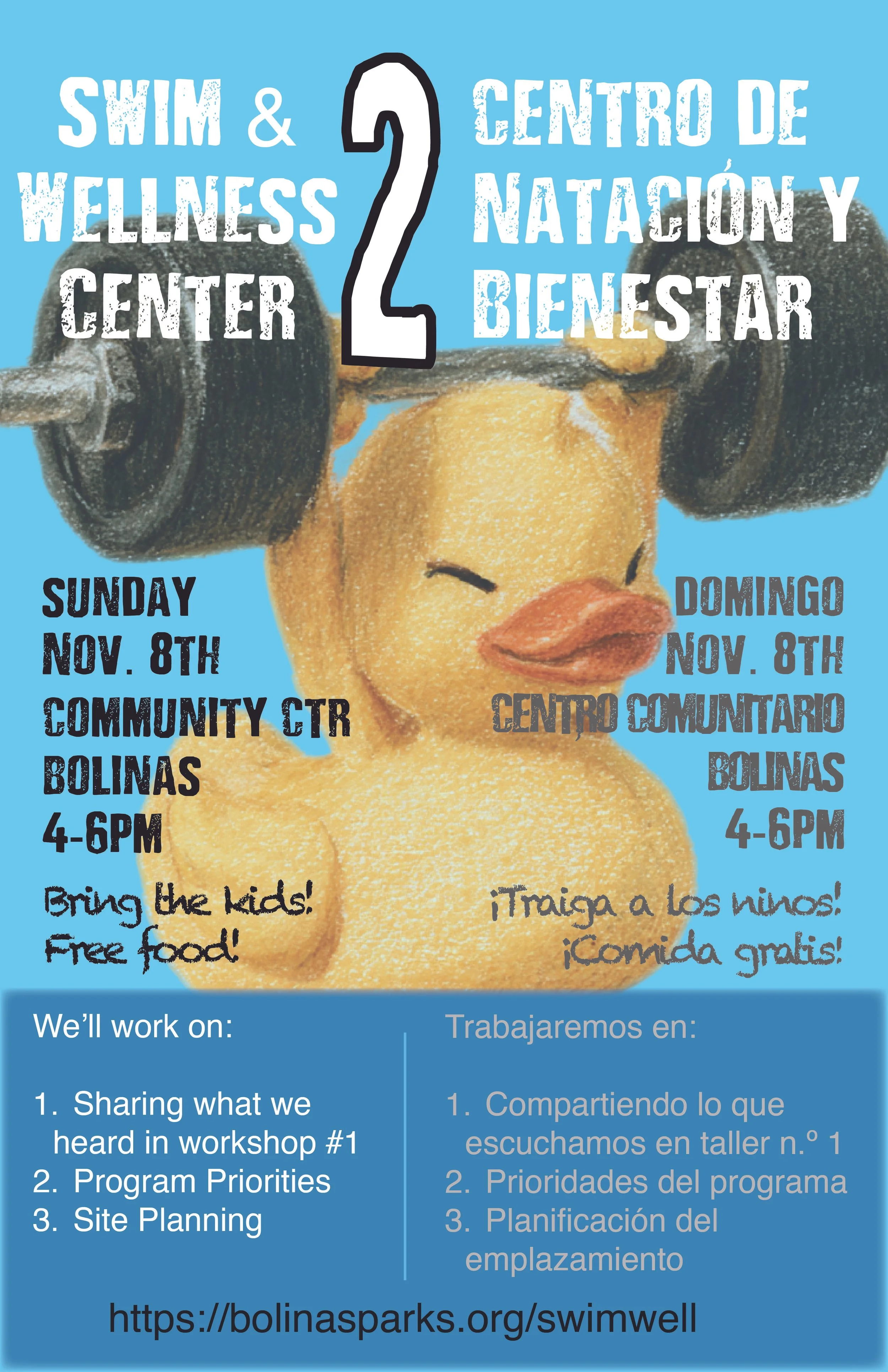
A West Marin swimming pool has been a long-held dream, with several Bolinas groups exploring it since the 80s. Mesa Park picked up the reigns in 2024, exploring the need for a dedicated facility and developing a strategic plan for building and operating a Swimming & Wellness Center. While our research initially focused on a swimming pool, we heard so much from the community about the need for broader indoor wellness that we would like to explore other indoor spaces - fitness room, basketball gym, multi-purpose rooms for yoga, Pilates, fitness classes, service rooms for massage, physical therapy, and acupuncture - to offer a complete wellness experience for the communities of Bolinas and Stinson Beach.
HELP US FUND COMMUNITY WORKSHOPS!
Make checks payable to:
Firehouse Community Park Agency
P.O. Box 461, Bolinas, CA 94924
Why Swimming & Wellness?
Our aging population needs safe, low-impact exercise.
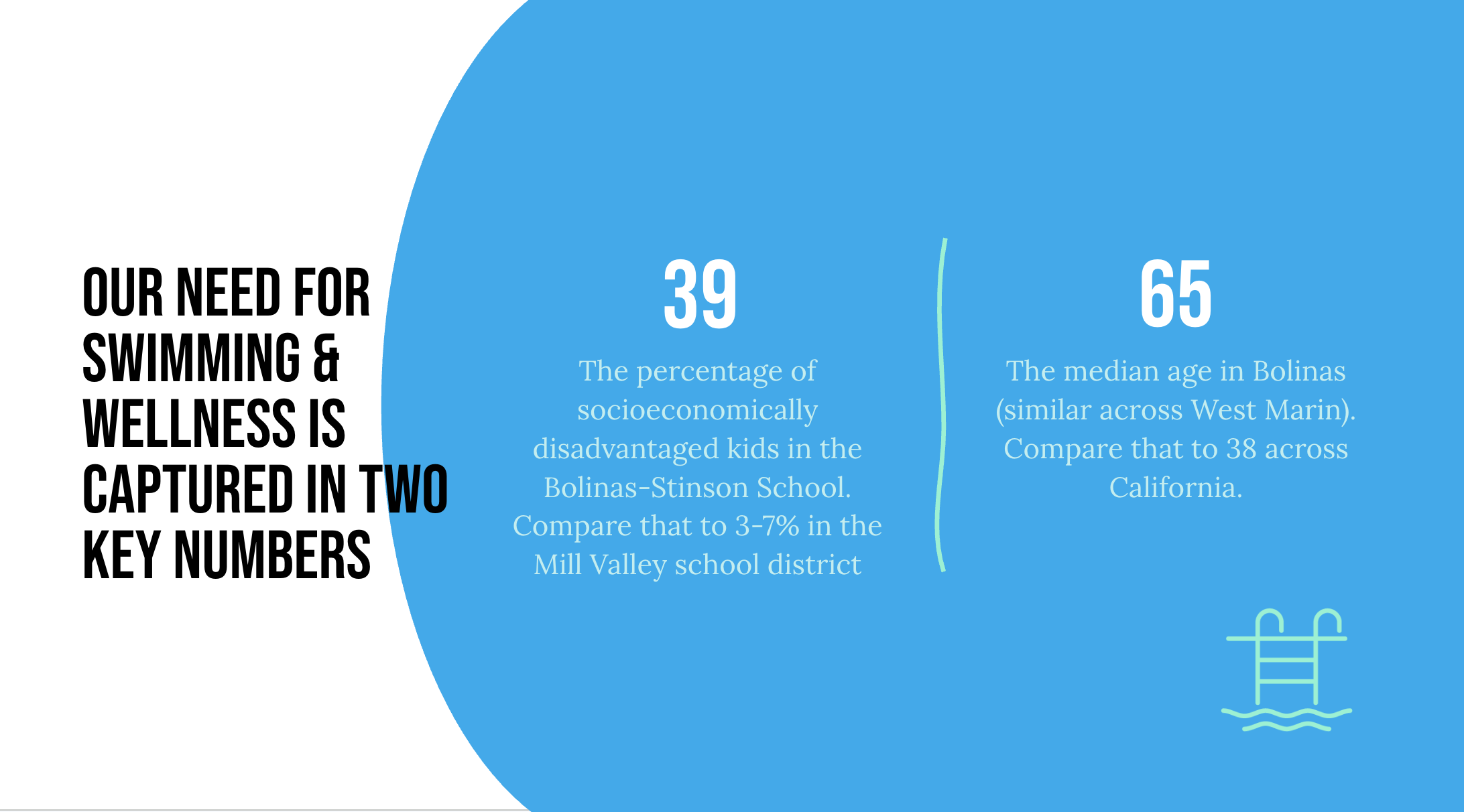
Our kids live next to the ocean and many do not know how to swim.
Drowning is the leading cause of death for children 1-4 years old, and adults 65+ are the second leading group.
Our isolation means that pools and wellness facilities are largely out of reach; the nearest one to Bolinas is a 45-minute drive “over the hill.” Most lack the time and money for a regular trip.
The Community
In 2024 we conducted a survey, the full results of which can be found HERE. We had respondents from all over West Marin, , 324 in total, with 58% coming from Bolinas. While we surveyed all of West Marin, residents of Bolinas and Stinson Beach were most likely to use a facility located at Mesa Park.
Seniors were a core group:
47% over respondents were over 60
80% of seniors have health conditions that would benefit from time in a pool
63% of seniors either never or rarely travel to other communities to use a swimming pool
86% would use a pool facility at least weekly
Kids were also highly represented. Of 195 kids represented in the survey, 95% of them would benefit from water safety.
Of respondents with children (130):
91% wanted swim lessons
70% wanted kids recreation swimming
30% wanted swim team
The Site
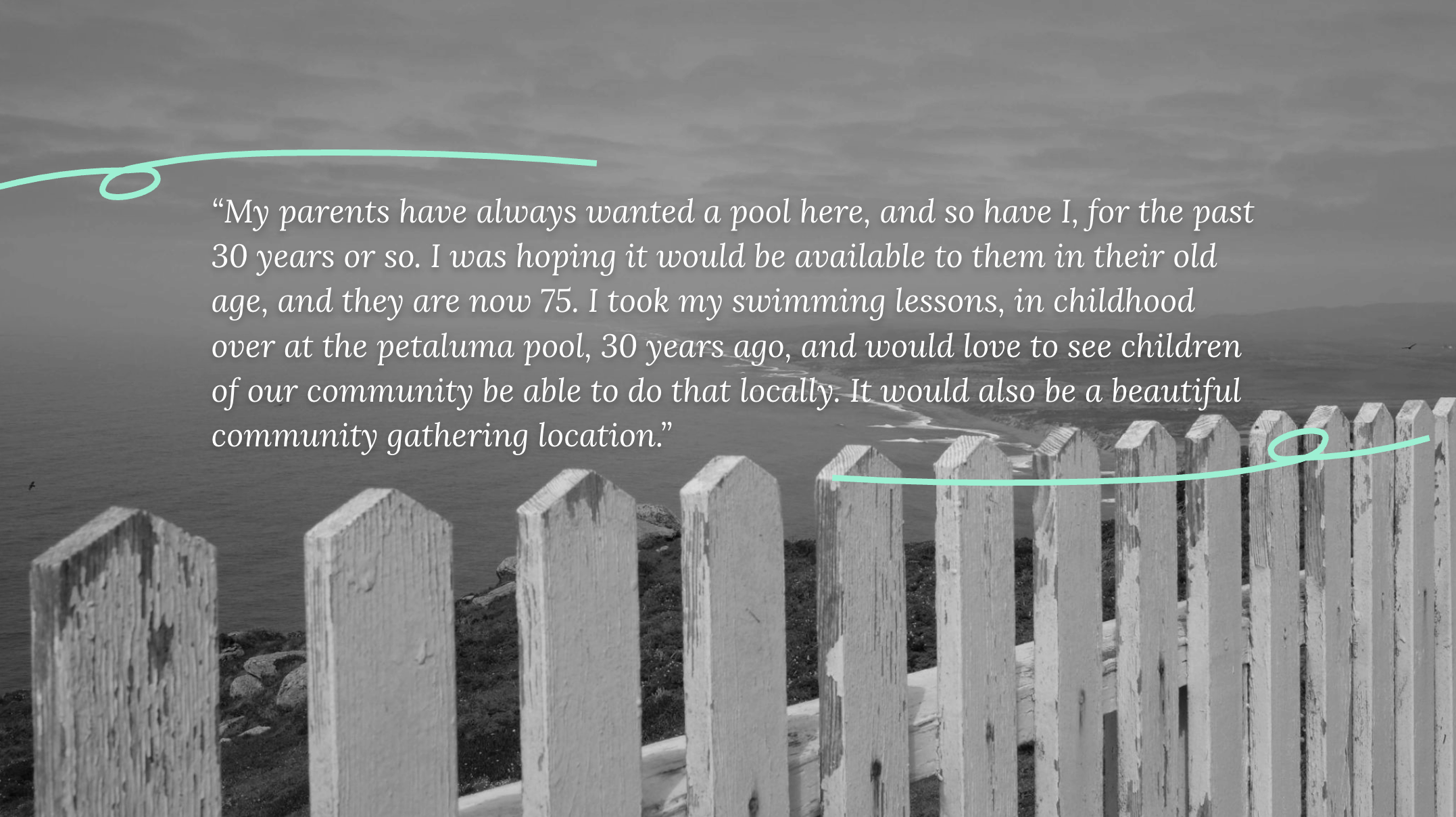
The Swimming & Wellness Committee has identified an available and approved site for a potential facility, at Mesa Park HERE. A former dirt bike track, an area of about 2 acres, in the northwest corner of the lot, about 60 yards from the firehouse building, where plumbing and electrical connections exist, has been identified as the preferred location. Flat and previously impacted, the site has also been subject to entitlement research in the past, as it was slated to be a second baseball field. This site is already publicly owned, saving significant costs in land acquisition.
In 2025, with the help of donations and a West Marin Grant, we conducted a legal review of the location with law firm Ragghianti Freitas, LLC. That REPORT and follow-up conversations with the firm indicated no red flags from a planning perspective and advised that the team proceed with the design process. Still, all of the appropriate studies will be conducted during the permitting process: archeological, biological, geological, and environmental.
The primary recreational site in Bolinas, Mesa Park is operated by the Firehouse Community Park Agency (aka Mesa Park), a Joint Powers Agreement between the Bolinas-Stinson School District and the Bolinas Public Utility District. Currently the Park hosts a soccer field, baseball diamond, skatepark, basketball court and playground. It has bathrooms and a 1-acre parking lot, but is just 0.1 miles to the most dense neighborhood in Bolinas. It is also home to the Bolinas Fire Protection District and the Coastal Health Alliance, which occupy two buildings at the front of the lot.
Building at Mesa Park necessitates a public facility, open to anyone willing to pay either the membership or drop-in fee. There are certain state requirements of a public pool, including a minimum amount of indoor space to support mechanical, bathrooms, offices, etc. Public pools are also required to staff lifeguards at all times.
Water
Whenever a project is proposed in Bolinas, the first question is invariably, “what about the water?” The Bolinas Community Plan of 1975 restricted the issuance of new water meters to account for the limits on the water source.
Mesa Park has been working extensively with the BCPUD to address the water needs of the proposed facility. Beyond the filling of a pool, the expected water use of a swimming and recreation facility is 400-570 gallons per day.
A pool and recreation facility would have four basic water uses:
Filling and draining / refilling a pool
Topping off pool loses from evaporation and spillage
Toilets, showers and drinking water
Irrigation (grey water only)
At the May 2026 Board Meeting, the BCPUD approved the exploration of four theoretical methods to support the water needs of a swimming facility beyond the limits of the existing water meter at Mesa Park.
Note: the board is signaling willingness to entertain these strategies, not authorizing construction or making binding technical commitments.
1. Swap-and-stack model
Establish a water use limit on the currently-unlimited downtown meter (based on historical usage)
Authorize a "swap and stack" mechanism allowing transfer of water allocation from the downtown meter to the Mesa Park meter
Direct staff to review/amend the district's Limited Water Use Permit (LWUP) resolution to extend the existing affordable-housing swap-and-stack precedent to "public benefit" purposes generally (under which Mesa Park would qualify)
2. Well Water Allocations
BCPUD is in the process of developing two emergency groundwater sources: the Resource Recovery Well and the 31 Wharf Road Well.
In order to maintain water quality and turnover, the District anticipates that these facilities will need to periodically introduce treated water into the potable distribution system even when not being relied upon as primary water sources during emergencies.
The Board discussed the concept of counting this operationally necessary water, estimated at approximately 500 gallons per day (250 gallons from each of the two wells), toward a stacked LWUP for Mesa Park, since that water would effectively offset an equivalent amount of demand that would otherwise be supplied by Arroyo Hondo Creek.
Any such augmentation of Mesa Park’s LWUP would remain subject to future drought conditions, water shortage emergencies, conservation requirements, and rationing measures. As with all LWUPs, it would establish a maximum allowable use under normal conditions and would not constitute an entitlement to a guaranteed quantity of water
3. Seasonal/winter pool filling using excess water
Authorizes using available excess winter/wet-season water (water that would otherwise flow down the Arroyo) for initial and periodic pool filling
Park would pay for treatment/metering as with any normal water purchase — akin to how contractors sometimes buy metered water from a hydrant
Refilling of a pool typically happen only every 3-5 years
In the case of the need for additional water, potable water can be trucked in and stored onsite. The design process will need to consider how to minimize potable water use, through extensive water capture and grey water strategies.
Water use will be impacted by other design decisions, such as whether the pool is indoor or outdoor, which greatly affects evaporation. The decision to operate the pool year-round or seasonally will also impact water use. These are currently open questions that will also be influenced by budget and community need.
Process
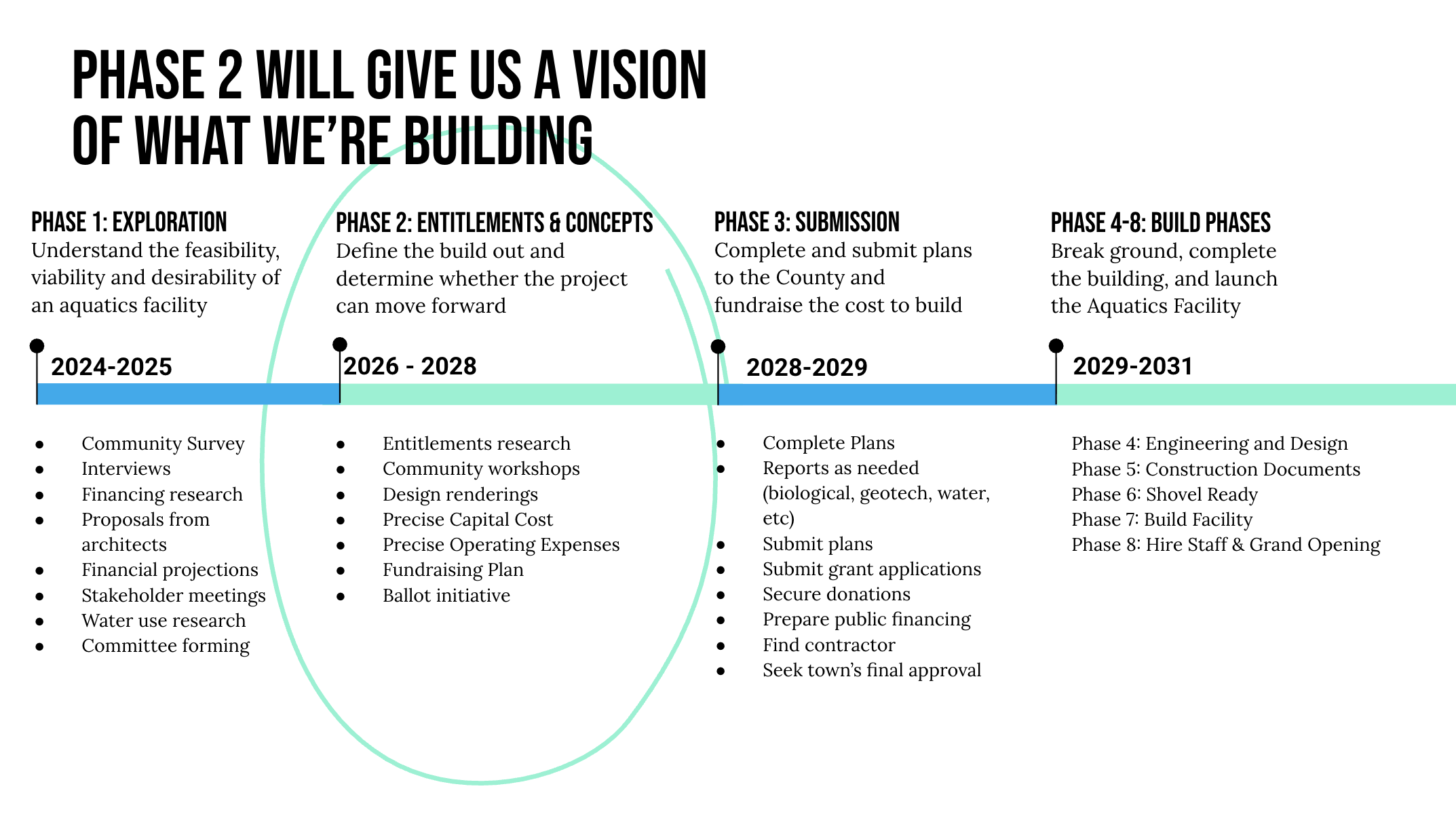
While a swimming pool and wellness facility has long been considered in Bolinas and Stinson Beach, it has never been brought to a vote. The steps we are taking now are intended to help us reach that milestone. That is, we plan to introduce a ballot measure in the communities of Bolinas and Stinson Beach that would ask voters to approve a general obligation bond to partially fund the construction of a pool. This would achieve two primary goals: 1) we would raise a portion of the money needed to build the facility, and 2) we could be confident that the community supports the project, as it would take a 2/3rds majority to pass such an initiative.
We believe that early and consistent community involvement will be critical to the success of the project, ensuring that any proposed facility deeply reflects the needs of the community. We are planning a participatory design process with multiple town workshops.
With that mind, and after a comprehensive search and interview process, we have hired the medium-sized architecture firm EHDD to help us with our initial visioning and design work. EHDD are experts in deep community engagement and we have been very impressed with their humility and curiosity as relates to our project. They have deep commitment to the environment and equity in their work and we are confident they will be able to reflect the desires and aesthetic of this place and people. You can read more about their history and practice HERE.
Design
Design of the facility will be a participatory process involving several community events to allow members of the public to express their vision for the project. From conversations to date and our survey, we identified a broad set of Guiding Design Principles that can be reviewed and challenged as the process moves forward.
Perfect for a 5 year old and a 70 year old
While the pool should service all members of the public, these are our priority age groups. If we provide a safe place for children to learn to swim, and a low-impact exercise option for the elderly, then we believe all age groups will benefit from the pool
A community gathering place
West Marin is a tight-knit region and that highly values community spaces and events. The facility should prioritize this desire, be a gathering place for swimmers and non-swimmers alike, and an opportunity for inter-generational socializing.
Adaptable to weather conditions
The Bolinas climate is temperate but variable, and the proposed site is subject to fog and wind, especially in the summer months; during these periods the air temperature can often be in the high 50s. Any design will need to carefully address these conditions and provide a comfortable environment for swimming and physical activity.
Reflective of the Bolinas architectural style
Any new development in Bolinas needs to carefully consider its architectural style. A typical aquatics facility in an urban environment - often dominated by cement and glass - is unlikely to be cohesive in Bolinas.
Embodies nature and minimizes impact
The design process will need to consider the inclusion of modern sustainability features, such as renewable energy, water capture and reuse, and others outlined by programs such as LEED (whether or not the building pursues certification).
Designed to reduce operational challenges
The operational challenges of running a pool are significant. Minimizing the staffing needs and the costs associated with operations should be considered in the design phase. Efforts like reducing utility costs through solar and battery, low-maintenance landscaping, and automation of check-in procedures may help offset operational expenses.
Paying to Build It
Building a swimming and wellness facility in today’s environment is an expensive undertaking. There is a large range of potential capital needs based on the type of facility we desire, too large a range to state at this time but suffice to say it will require a committed and creative fundraising effort.
Decisions that we make in the design process will greatly dictate how much capital we need. There are likely to be some opportunities to reduce and cover operating expenses by investing more capital in things like solar power. While we don’t know at this point how much capital will be available to us, we do know that value design and engineering will be critical from the get-go.
Fundraising is a full-time job, so engaging the services of a local professional will be the first and most critical activity that we will need to fund.
We plan to fund the facility in three ways, broken down more or less equally:
1) General Obligation Bond
Passing a bond would assess property per $100k of value, at a determined rate. So for example, we might propose to assess at $20 per $100k; if you were a home owner and your home was worth $1M, you would pay $200 annually to support the GO bond. Those registered to vote in West Marin would determine if this passed, and all properties would be assessed. The actual structure of the payments is more nuanced than that, but this gives a general idea. We expect that if such a bond measure could pass in Bolinas and Stinson Beach (and Seadrift) we would raise about one third of the capital needed to build the facility.
This is a significant effort, and while we have had initial conversations with experts in this space, the services of a taxing consultant would be solicited. Other public funding mechanisms might be preferable to the GO bond route (such as a parcel tax), and those will be examined.
2) County, State and Federal Grants
There is significant funding available through grants at various levels of government. They can be difficult to unlock however, and require careful planning and structuring in the design process. Grants for park development, physical wellbeing, senior care, socioeconomic challenges, and disaster preparedness might all apply to our effort if considered early. We plan to engage the efforts of an experienced grant writer to help us navigate this process.
One promising grant from the State is called the Statewide Park Development and Community Revitalization Program, which awards up to $8.5M to creat new parks and new recreation opportunities in underserved communities across California. Depending on the community priorities, other grants may include a resiliency grant from the Department of Food & Agriculture. A small town east of Fresno called Kermin recently secured $7.25M to expand a community center, including enhanced recreation facilities.
More locally, the County of Marin is undertaking a “West Marin Visioning” effort to strengthen community and economic resilience. A swimming and wellness facility could be a core part of that strategy.
3) Private Donor
As is typical in West Marin, private donations will play a critical role in financing the capital expenditures of the project. The new Stinson Beach fire station is a testament to the commitment of donors in West Marin, having raised over $14M in less than two years.
Many residents have expressed their support for the swimming and wellness project, so we are hopeful that financial support will follow, recognizing that raising substantial private funding will take a dedicated effort.
We hope to fund one third to one half of the needed capital through private donations, including an additional endowment fund to support ongoing operations and maintenance needs beyond what our operational revenue will be able to cover.
Operating It
Aside from concerns about water, operating expenses have been the biggest sticking point with previous attempts to build an swimming facility in West Marin. Given our relatively small resident population - 4300 across West Marin, 1500 in Bolinas - the income potential for a facility is limited. Typical revenue sources include memberships, drop-ins, swim lessons, party rentals, and camps. The large number of visitors to the region is a potential revenue source that is a difficult to pin-point, but a critical contributor to drop-in fees and event rentals.
The operating viability needs to be central to the initial design of the facility, from both the revenue and expense perspectives. How can the facility support event rentals like weddings? Or paid services like personal training or massage? How can the design help us reduce our utility costs? Our staffing costs? These are all important questions to consider from the get-go.
Still, we should expect the facility to operate at a loss. A shortfall is not universal; we have spoken to small communities who manage to cover the cost of their aquatics programs. But it should be expected. Staffing expenses are significant, given the need for at least one lifeguard during all swimming open hours, as well as management, cleaning and maintenance. Other major expenses include utilities and pool service. An annual loss is not unusual for a community pool, and our research suggests that 60-70% of expense coverage is likely. In many communities, the difference is paid out of city coffers. As unincorporated towns without a central budget, this is a challenge for Bolinas and Stinson Beach. Additionally, given the high percentage of low-income residents, we expect some allowance be made for a sliding scale membership program.
Beyond examining all potential sources of income and reducing expenses, we expect to fund our shortfall through an endowment fund. This money would be raised through private donors, as part of the initial capital fundraising effort. These donations would be invested safely and the proceeds used to fund the operational shortfall. Ongoing grants will support operations as well, but again, the exact value is hard to pinpoint.
We continue to work on financial projections. We are happy to provide further detail and answer any questions. As we enter Phase 2 of our project, we will budget for professional forecasting.
More Information
We have done a lot of research on this project! If you have additional questions, we may have answers (or at least would be happy to find out). Please contact our project lead, Simon Dunne for more information, dunner6@gmail.com. And sign up for our newsletter!
Quisque iaculis facilisis lacinia. Mauris euismod pellentesque tellus sit amet mollis.